

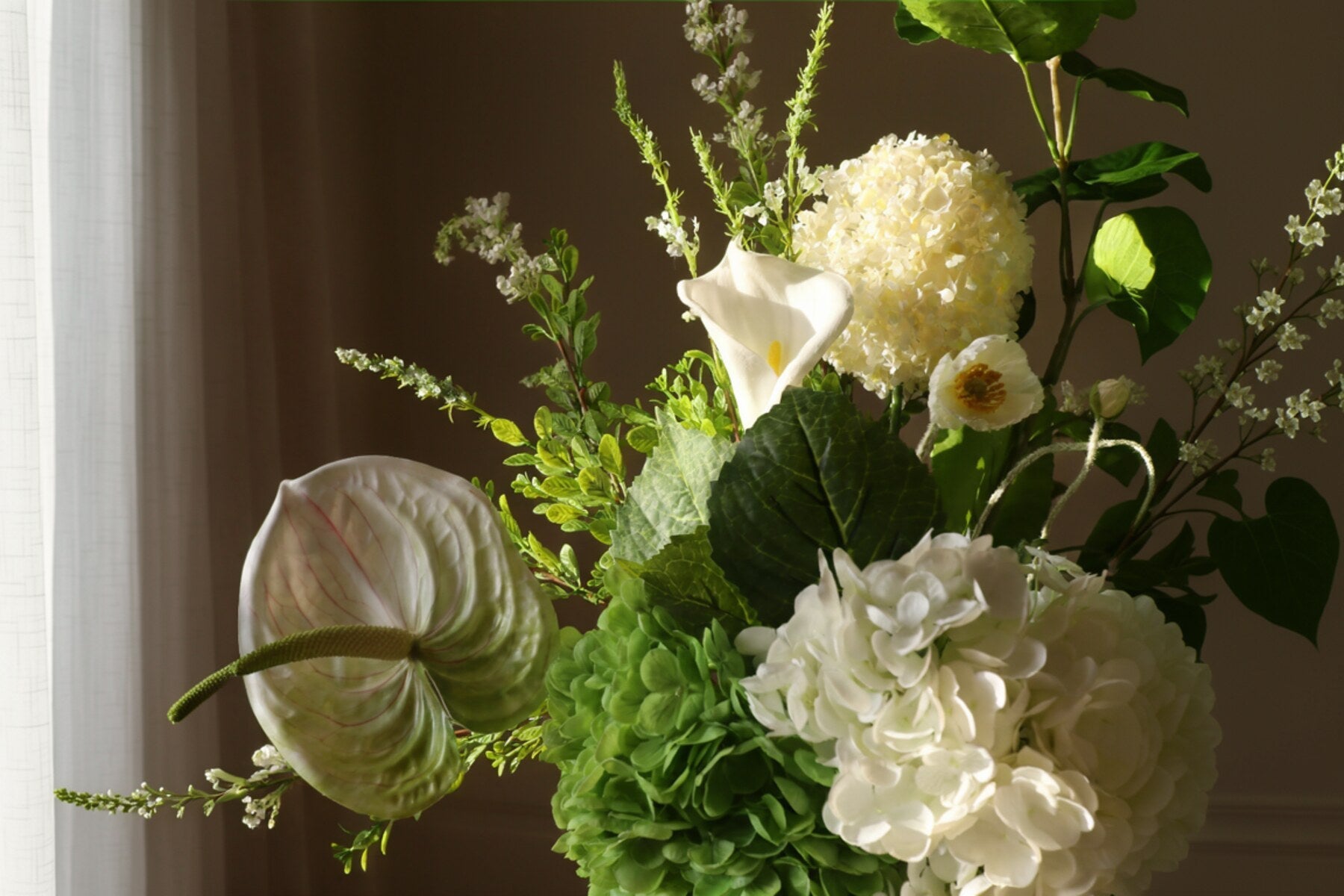
Botané vs. Cheap Artificial Flowers: The Difference
"Aren't all artificial flowers the same?" It's a question we hear more often than we'd like. Because the difference between our Botané collection and the plastic varieties you find at a garden center or online marketplace is enormous — and determines whether your decor still looks professional in 5 years or has long since ended up in the trash. In this article: an honest comparison between premium artificial flowers and cheap alternatives, focusing on materials, lifespan, and total cost over time.
The problem with cheap artificial flowers
Cheap artificial flowers — think bouquets for €5-15 at a garden center or marketplace — sometimes look acceptable at first glance. But in a business environment, the following becomes apparent after a few weeks:
- Plastic sheen: the flowers reflect light unnaturally — they look "fake" from a distance
- Discoloration: within 6-12 months, they discolor due to UV exposure, especially pink and red shades
- Stiff shapes: the stems and petals remain exactly in the shape chosen by the factory — no natural variation
- Glue residue: glue is often visible at the base of the petals
- Crumbly texture: small particles come loose and fall onto furniture
- Cheap smell: some cheap varieties smell of plastic or chemicals
What makes premium artificial flowers different?
Premium artificial flowers such as the Botané collection differ fundamentally in four ways:
1. Materials
Botané uses high-quality silicone with a "real-touch" finish — a rubbery, soft texture that mimics the surface of a real flower. In addition, high-quality polyester and EVA foam for petals that bend naturally. Cheap artificial flowers use stiff plastic and synthetic textiles.
2. UV stabilization
Botané flowers are treated with UV stabilizers that preserve their color for 5-8 years. Cheap artificial flowers discolor noticeably within the first year.
3. Handmade composition
Every Botané bouquet is hand-assembled by florists. This means that no two bouquets are exactly alike — there is natural variation. Cheap bouquets are machine-assembled in identical patterns.
4. Stems with flexible metal
The stems of premium artificial flowers have a flexible metal wire in the core, allowing you to shape them and adapt them to your vase. Cheap varieties have stiff plastic stems.
Comparison of total costs over 5 years
The apparent advantage of cheap artificial flowers disappears as soon as you look at the real picture:
| Aspect | Cheap (€10/bouquet) | Premium Botané (€85/bouquet) |
|---|---|---|
| Purchase | €10 | €85 |
| Lifespan | 6-12 months | 5-8 years |
| Replacements over 5 years | 5-10x | 0-1x |
| Total costs over 5 years | €60-100 | €85 |
| Appearance year 1 | Marginal | Premium |
| Appearance year 5 | N/a — replaced | Still premium |
| Impact on brand perception | Negative | Positive |
The figures are comparable — but the appearance and the effect on customer experience are not at all.
The hidden costs of cheap artificial flowers
In addition to the pure price tag, there are three hidden costs of cheap artificial flowers:
Reputational damage
Customers who see "fake-looking" bouquets at a reception unconsciously associate that with "the company is cutting corners on visible details — what else are they cutting corners on?". In professional environments, this can have a real impact on trust.
Time for replacement
Someone has to spend time replacing discolored or damaged bouquets — on average 2-3 times a year for cheap varieties. Calculate it against the hourly wage of your facility team.
Waste disposal
Cheap artificial flowers are not recyclable and end up in general waste. No circular story, no sustainability claim possible.
When are cheap ones appropriate?
Honestly: not every situation requires premium. Cheap artificial flowers can work for:
- Temporary events (one-time wedding, one-time opening)
- Stage settings for photoshoots
- Private use at home where the appearance is less critical
- Decoration in areas not visible to customers
But for business environments where flowers are part of the brand image, "cheap" is almost always more expensive in the long run.
How to recognize premium quality?
Three tests you can do:
- The "squeeze test": press a petal. Premium silicone feels soft and flexible; cheap plastic cracks
- The "distance test": view the bouquet from 2 meters away. Do any "fake elements" stand out? Not with premium
- The "bend test": can you gently bend the stems for composition? Premium can, cheap snaps or cracks
Frequently asked questions
Is Botané really so much better than cheap artificial flowers?
Yes. The difference is immediately visible when you place both side by side. We are happy to send a sample for comparison upon request.
How do I know it will last 5-8 years?
We guarantee color fastness and material quality. In practice, we see that early customers (5+ years ago) still have their bouquets in top condition.
Can I mix premium and cheap?
Not recommended. The difference is immediately visible, and the cheap variant detracts from the premium.
Is there an intermediate level?
The market offers mid-range options between €25-50 per bouquet. These are better than cheap varieties but do not achieve the lifespan and appearance of premium. For business applications, we do not recommend them.
Compare on-site
Want to see the difference for yourself? Request a no-obligation sample via hello@blooms.nl or schedule a meeting via the workspace advisor. They can visit you with examples so you can feel and see the difference in quality live.
Read more
How tech and industrial companies in the Brainport region use Blooms for design-conscious floral arrangements.
How tech and industrial companies in the Brainport region use Blooms for design-conscious floral arrangements.